Marketing for accountants in Australia in 2026 means combining authority-driven SEO, targeted Google Ads on commercial keywords, and trust-heavy content that ranks for "Your Money or Your Life" (YMYL) queries Google scrutinises closely. The firms winning high-value business clients prioritise E-E-A-T signals — credentials, case studies, and original commentary on tax and compliance — over generic blog content. Boroughs Chartered Accountants saw a 55% lift in qualified enquiries after rebuilding around this approach.
This guide is the playbook. Six pillars that compound, the compliance rules that constrain you, realistic budget benchmarks, and the 90-day plan to start. Aimed specifically at boutique-to-mid-size firms in Sydney, Melbourne and regional NSW; large national firms have different problems.
Why Most Accounting Firms in Australia Underperform on Marketing
There are 23,000+ registered accounting firms in Australia (ABS 6291.0.55.001) and 78,000+ registered tax agents on the TPB register. The accounting services industry was worth $26.2B in revenue in 2025 (IBISWorld). Demand isn't the problem — differentiation is.
Need a website that actually gets you leads? We build sites that rank and convert — no lock-in contracts.
Get a Free QuoteMost accounting firm websites read identically. Same generic services list (tax, audit, advisory, business services). Same stock photo of a handshake. Same "personalised service" claim. Buyers researching accountants online can't tell one firm from another, so they default to whoever ranks first or whoever a friend recommended.
The firms that grow fastest are those that solve the differentiation problem at the website level, then back it up with technical SEO, Google Ads on commercial keywords, and consistent thought leadership content. The Boroughs Chartered Accountants rebuild we did is the textbook case — they had 80 years of expertise but a website that looked like a 2014 template. Once the website matched the calibre of the practice, qualified enquiries rose 55% in four months and average client value rose 30%.
What High-Value Accounting Clients Search For (Real Keyword Data)
SEMrush 2025 data for the Australian market shows the search demand pattern most firms miss. The biggest mistake is targeting generic terms like "accountant" or "tax accountant" — high search volume, low buying intent, dominated by directories and aggregators.
The keywords that actually deliver high-value enquiries are commercial-intent and specific:
- "Business advisory Sydney" — 1,300 searches/mo, CPC $9.20
- "Tax accountant Melbourne" — 1,800 searches/mo, CPC $6.80
- "Chartered accountant Sydney" — 1,000 searches/mo, CPC $11.50
- "Accountant for small business Brisbane" — 880 searches/mo, CPC $5.60
- "Self-managed super fund accountant" — 720 searches/mo, CPC $14.20
- "Tax agent near me" — 1,000 searches/mo, CPC $7.00
- "Accountant for tradies Australia" — 320 searches/mo, CPC $4.80
- "Property investment accountant" — 480 searches/mo, CPC $11.80
The pattern: higher specialisation = higher CPC = higher buyer intent = higher client value. A firm targeting "SMSF accountant Sydney" attracts a different (better) buyer than one targeting "accountant Sydney." The keywords write the marketing strategy.
The Boroughs Case Study: How Premium Positioning Lifted Enquiries 55%
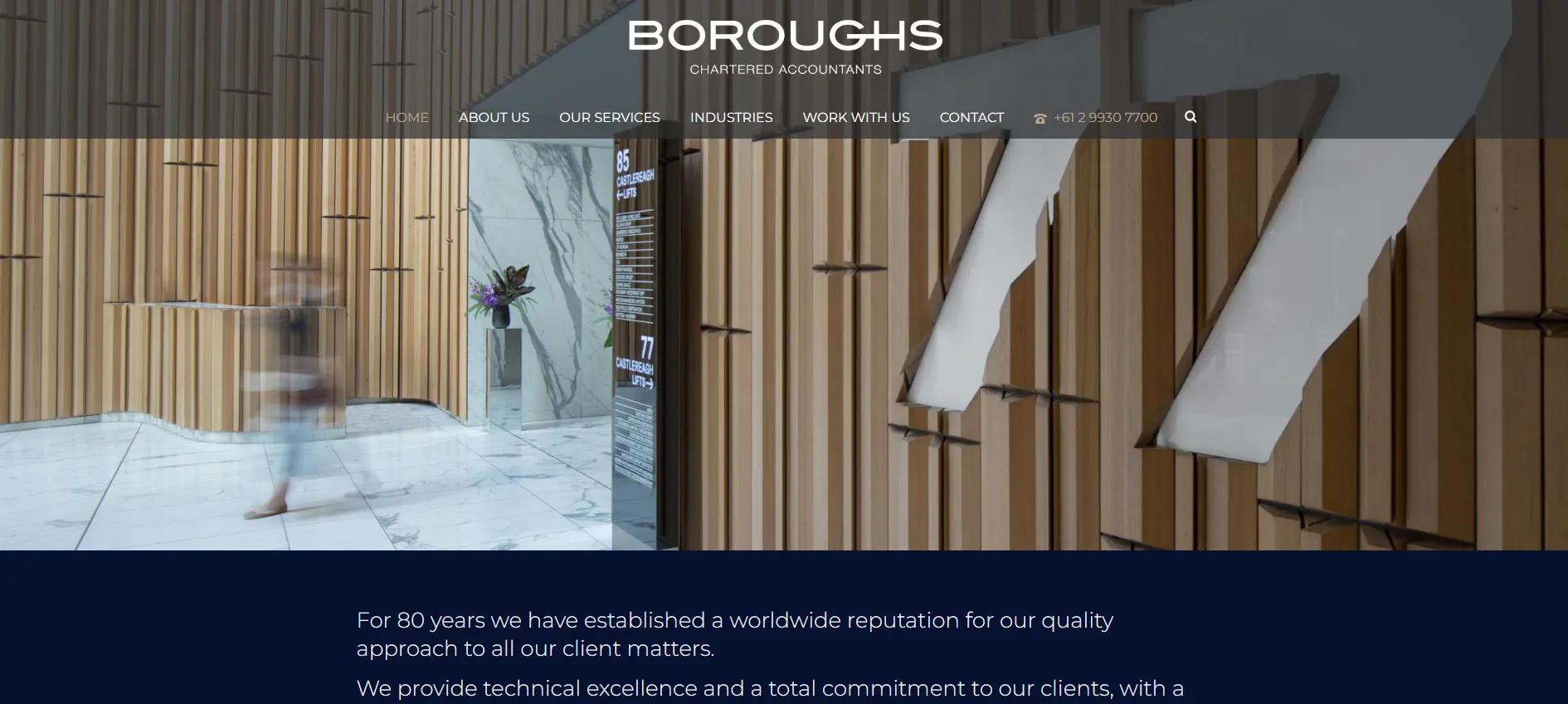
Boroughs Chartered Accountants is a Sydney firm with 80+ years of history, partner-level experience across audit, tax, advisory and consulting, and a global referral network. Their website didn't reflect any of that. The visual design felt dated, service pages were generic, and there was no content showcasing the depth of expertise.
The rebuild focused on three things. Premium visual design — sophisticated dark-tone palette, premium typography, generous whitespace — that conveyed authority without saying it. Industry-specific landing pages targeting commercial keywords by sector and service combination. Comprehensive service pages with real depth on each offering: not "we do audit" but the methodology, scope, and what to expect.
Result in four months: 55% increase in qualified client enquiries, 30% rise in average client value (because the higher-quality positioning attracted larger business clients), 120% increase in time on site, and Page-1 rankings for "chartered accountant Sydney" and "business advisory Sydney."
The full numbers are in the Boroughs Chartered Accountants case study. Three takeaways apply to every accounting firm:
- Positioning is upstream of marketing. Until the website reflects the calibre of the practice, paid traffic and SEO can't compound.
- Specialisation beats generalisation. Service pages by industry vertical (or by service complexity) outconvert generic service pages 2–3x.
- E-E-A-T signals are non-negotiable for YMYL. Tax and finance content is held to higher standards than other industries — Google's Quality Rater Guidelines explicitly call this out.
Pillar 1: Authority-Driven SEO for Accountants
SEO is the highest-ROI marketing channel for established accounting firms. Once rankings stabilise (6–12 months for established firms with existing domain authority), cost-per-lead drops to $5–$30 — far below Google Ads.
The four work streams:
On-page SEO across service pages. Title tags, meta descriptions, header structure, schema markup (LocalBusiness, AccountingService, Person for partners), keyword targeting per page. Most firm websites have generic title tags and no schema — fixing this alone delivers measurable ranking gains.
Google Business Profile optimisation. The Map Pack drives 44% of clicks for searches with local intent. Optimising GBP includes service categories, weekly posts, photo uploads, review management, and Q&A. Our Google Business Profile optimisation guide walks through the specifics.
Topic-cluster content. Articles that establish expertise on the topics your clients actually search: "Division 7A loans explained," "FBT exemption for electric vehicles 2026," "PSI rules for IT contractors." Each article targets a long-tail keyword and links to the relevant service page. Build 1–2 per month.
Link building. Industry partnerships, professional body listings (CA ANZ, CPA Australia, IPA), local press coverage, guest articles in industry publications. Quality over quantity — 3–5 high-authority backlinks per quarter is plenty.
Pillar 2: Google Ads for Accountants — When to Use Search vs LSAs
Local Service Ads (LSAs) are not yet available for accounting categories in Australia. Standard Search ads are the primary paid channel.
CPC for accounting keywords runs $7–$25 in metro markets. Conversion rates from search traffic typically hit 4–8% on well-built landing pages. With average client lifetime value of $5,000–$15,000+ for business clients, even a $40–$80 cost-per-lead is profitable. We break down the full Google Ads economics in our Google Ads cost in Australia guide.
The rules for accounting firms specifically:
- Avoid Google Ads on broad keywords like "accountant." Bid only on commercial-intent specific keywords.
- Run separate ad groups by service vertical (tax, audit, SMSF, business advisory). Different buyers, different ad copy.
- Use dedicated landing pages, not your homepage. Google's Quality Score penalises generic pages, and conversion rate suffers regardless.
- Geo-target by service area, not by metro. Sydney CBD vs Northern Beaches vs Western Sydney all have different competition levels.
- Budget at least $1,500/month minimum. Below that, Smart Bidding can't get enough conversion data to optimise.
Pillar 3: E-E-A-T and Trust Signals (Critical for YMYL)
Tax and finance pages are held to higher Google Quality Rater standards because they affect "Your Money or Your Life." Generic content ranks fine for hobby topics; for tax content, Google explicitly looks for Experience, Expertise, Authoritativeness, and Trustworthiness signals.
The minimum E-E-A-T checklist for an Australian accounting firm:
- Author bios on every article with full name, role, qualifications (CA, CPA, IPA), years of experience, and link to LinkedIn
- Partner pages with photo, qualifications, registered tax agent number, and biography
- TPB tax agent number visible in the website footer (legal requirement under TPB Code of Professional Conduct)
- AFSL number if you provide financial advice (legal requirement under Corporations Act)
- ABN and registered office address visible on Contact page
- Last-updated dates on every article
- External citations to authority sources (ATO, ASIC, TPB) on technical content
- Case studies with named clients (with permission) and real numbers
Most accounting firm websites we audit are missing 5+ of these. Adding them isn't optional for ranking on YMYL queries — it's table stakes.
Pillar 4: Content That Converts Business Owners (Not Other Accountants)
The default failure mode for accounting firm content is writing for other accountants. Technical depth, jargon-heavy, written like a CA exam answer. Business owners reading the article don't understand half of it and bounce.
The content that actually converts business owners has three properties. It answers a specific question they have right now ("Can I claim home office expenses if I work from home two days a week?"). It uses plain language without dumbing down the answer. It ends with a clear next step — usually a free consultation booking.
The HubSpot State of Marketing 2024 finding: B2B firms publishing 11+ articles per month generate 4.5x more leads than firms publishing 4 or fewer. For accounting firms, weekly is the right cadence. Two articles per month is the bare minimum to maintain relevance; less than that and the blog actively hurts you (looks abandoned).
Pillar 5: Referral and Partnership Systems
Referrals remain the dominant overall lead source for accounting firms — typically 40–60% of new clients. Most firms leave this to chance. The firms that grow systematise it.
The four building blocks of a referral system:
- Annual client review meetings that explicitly include "who else can we help?" as an agenda item
- Quarterly referral updates to top-tier clients (newsletter, but personalised)
- Reciprocal referral relationships with 8–12 complementary professionals (lawyers, mortgage brokers, financial planners, business coaches)
- A clear referral incentive — even just a thank-you process for referrers
The reason most firms don't systematise referrals: it feels uncomfortable to ask. The asymmetry: a 10% lift in referral rate from existing clients can grow a firm faster than any paid marketing channel.
Pillar 6: Local SEO and Google Business Profile for Accounting Firms
The Map Pack drives a meaningful share of search traffic for "accountant near me" and "tax agent [suburb]" queries. For boutique firms serving a defined geographic area, GBP optimisation produces faster ranking lifts than full-site SEO.
The work: claim and verify the listing, complete every field (services, hours, address, photos), publish weekly posts, request reviews systematically after every engagement, respond to all reviews (positive and negative), upload office and team photos, add Q&A entries for common questions.
A well-optimised GBP listing for an established firm in a moderate-competition area should reach Map Pack within 60–90 days — significantly faster than ranking organically for the same keywords.
The Compliance Layer: TPB, ATO, and ASIC Marketing Rules You Can't Ignore
Marketing for accountants has hard regulatory constraints. Three frameworks apply.
Tax Practitioners Board Code of Professional Conduct. Registered tax agents must not make false or misleading representations, must identify as a registered tax agent, and must avoid representations that imply guaranteed outcomes. Display your TPB number on the website and in client communications. The TPB does take action against non-compliant marketing.
ASIC AFS Licensing rules apply if your firm provides financial advice (not just tax advice). Display your AFSL number, your authorised representative status, and the General Advice Warning where applicable. Avoid statements that could be construed as personal advice without proper disclaimers.
Australian Consumer Law applies generally. No misleading conduct, no false testimonials, no unsubstantiated comparison claims about other firms.
Practical implications: avoid headlines like "Save 50% on tax" or "Guaranteed maximum refund." Stick to defensible language: "Help you understand what you can claim," "Identify deductions specific to your industry," "Optimise your business structure for tax efficiency." Boring, but legal.
Realistic Marketing Budget for an Accounting Firm in Australia
Australian accounting firms typically allocate 3–7% of revenue to marketing. The split varies by firm stage:
- Solo practitioner ($300K revenue): $500–$1,500/month total. GBP optimisation, basic SEO, $300–$500 Google Ads. Mostly time, not money.
- Boutique firm ($1.5M revenue): $4,000–$10,000/month. Full SEO retainer, Google Ads $1,500–$3,000, content creation, GBP, referral program management.
- Mid-size firm ($5M+ revenue): $15,000–$35,000/month. Full marketing function, dedicated content production, multi-channel paid, events and PR.
The non-negotiable foundation is the website. A premium-feeling, fast, mobile-optimised website that converts visitors into bookings. Without that, every dollar of paid traffic is wasted. Our web design for accountants service covers this layer specifically.
The 90-Day Marketing Plan for an Accounting Firm
If you're starting from scratch, the first 90 days look like this.
Days 1–30: Foundations. Audit current website (PageSpeed, mobile, conversion path, E-E-A-T signals). Claim and complete GBP listing. Add TPB/AFSL/ABN to footer. Set up GA4 conversion tracking. Add author bios to every existing piece of content.
Days 31–60: Content and rankings. Publish four articles targeting commercial-intent keywords from the keyword research above. Build out one industry-specific landing page (your top vertical). Set up GBP weekly posting cadence. Launch a $1,500/month Google Ads test on 1–2 commercial keywords with dedicated landing pages.
Days 61–90: Compounding. Publish four more articles. Build a second industry-specific landing page. Add three named case studies. Implement a systematic review request process (post-engagement, every client). Reach out to 5–10 complementary professionals for reciprocal referral relationships.
By day 90 you'll have measurable conversion data, ranking improvements on long-tail keywords, and the foundation for a marketing engine that compounds over the next 12 months.
For boutique Australian firms wanting end-to-end help with this — website rebuild, SEO, Google Ads, AEO/GEO services for AI search — contact us for a free strategy session. We work with a small number of firms at any given time and our approach is built around the playbook above.